Foot Care
Foot Care
Mobility
The Spiral
Starting from a general mid-point of the foot, begin to move outwards in larger and larger spirals. Once the edges of the toes and the fat pad have been reached, spiral back towards the middle in smaller and smaller circles.Back and Forth Lengthwise
Place the ball right in front of the fat pad of the heel. From here, trace a straight line all the way up to the base below the big toe and back again. Next, trace a line from the starting point in front of the heel all the way to the second toe and back. Continue the same process all the way to the little toe. Once the line from the fat pad to the little toe has been traced, repeat the journey back to the big toe. Once all the lines of the toes have been traced back and forth, we recommend repeating the cycle one more time.Back and Forth Width wise
Beginning right in front of the fat pad, move sideways around the edge of the fat pad to the inner arch. Once there, move back the other direction to the outer arch. From here, move the ball up about 1-2 centimetres on the foot, and move back towards the inner arch. Once the inner arch is reached, return in the same line to the outer arch. Repeat this process until a line is made back and forth at the base of the toes, and then repeat the journey back down to the front of the fat pad. Once all the lines of the toes have been traced back and forth, we recommend repeating the cycle one more time.Under and Between the Toes
This exercise is generally recommended with a smaller massage ball for more manoeuvrability. Begin with the ball under the big toe. If the tissues of your big toe are tight and the ball of your foot under the big toe cannot reach the floor, then just keep lightly pushing the ball of the foot towards the floor in an attempt to increase the stretch. If the ball of the foot can reach the floor, begin to slightly lift the heel off the ground to increase the stretch. Roll the toe back and forth on top of the ball to stretch the toe from multiple angles. After you are satisfied with the stretch, roll the ball in between the big toe and the toe next to it. Try to fit the ball directly in between the toes. If not possible, work on this stretch as much as possible. If you are able to fit the ball between your toes, then try to lift the ball in the air by squeezing the toes together. This squeeze will increase the stretch drastically, so don’t be alarmed when attempting it. Once you’ve stretched the toes around the ball or squeezed the ball to a satisfactory degree, move the ball underneath the second toe and repeat the stretching process from the big toe. Once finished, repeat the process of stretching between the second and third toes, and so on. Once the pinkie toe has been reached, repeat the journey back to the big toe. Once all the toes have been stretched properly, we recommend repeating the cycle one more time. Toe Spreaders The widest part of the human foot is anatomically meant to be from the Hallux to the pinkie toe. Many of us have had our beautiful toe spread stolen by tight toe boxes. The ones who feel the negative effects of this the hardest are those that have hallux valgus or pinkie varus. When these toes cannot abduct outwards, the arches of the foot lose the support and control that each toe has to offer. It is absolutely possible, through perseverance, to restraighten the toes without surgical intervention. The use of toe spreaders is the act of forcing the toes to abduct to a maximal degree and stay in that position for long periods of time. When thinking about the foot and what we are trying to correct, it can be compared to a computer, in that we are trying to fix both the hardware and the software:The Hardware
The interconnective fascia and muscles of the foot. When these soft tissues are tight and stuck together, they will mechanically resists the opening of the toes, even if the nervous system tells the toes to open.The Software
The nervous system. When any nerve is used repetitively, the myeline sheath around it thickens causing the insulation of the electric signal from the nerve to the muscle to travel much more smoothly. When the big toe is locked into hallux valgus, the nerves attached to a muscle like the adductor halluces which brings the toe inwards are much more used to firing than the abductor halluces that spreads the big toe outwards. By wearing toe spreaders while standing and walking for a few hours a day, the tissues and nerves between the toes are forced to work in this position. This causes the muscles and nerves to strengthen in this weakened range. It is recommended also to sleep with the toe spreaders, as the lengthy time spent with the toes spread will also cause a gradual and gentle increase in the length of the tissues between the toes. However, this is not a task taken lightly. It requires consistent use of toe spreaders. It can potentially up to a year of daily use for a few hours at a time and full night's of sleep for results to be palpable. To speed up the process of this physiological change, it is recommended to practice mobility exercises while wearing the toe spreaders that challenge the tissues and nerves. When combining toe spreaders and mobility exercises, the tissues and nerves attached to the toes are challenged to a greater degree than day to day activities. You can tell you are no longer gaining any benefit from the toe spreaders if:- The big toe and pinky toe have much more range than the toe spreaders offer, even after pushing expanders into the available gaps between the big toe and pinky toe.
- Even after cutting and customizing the toe spreaders to sit well on the foot, they always fall off after short periods of use.
- The year mark has been reached after consistent use.
Fingers Between Toes
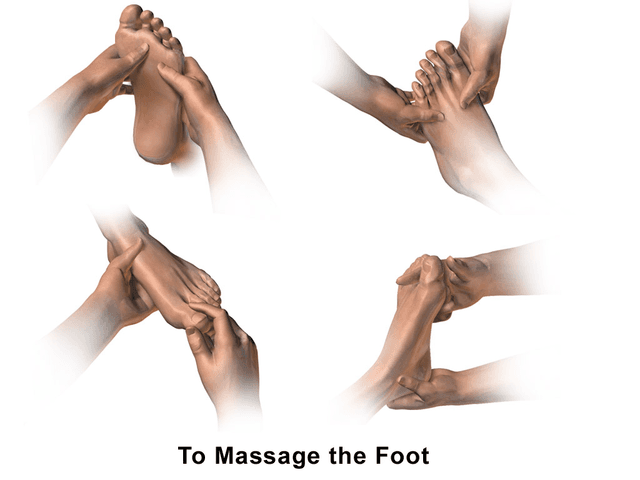
From a sitting position, interlock the fingers of one hand with the opposite foot. From here, perform the following motions:- Roll your hand around in clockwise and counter clockwise motions.
- Push your toes backwards into extension and pull them into flexion.
- Pull the toes away from your body, as if you wanted to pull them straight off the foot (don't worry, they wont actually fall off).
- Spread your fingers as wide as you can, trying to push the toes to the sides. Hold for 5 seconds, and then without closing the fingers, try to squeeze your toes together to resist the spread your fingers. Hold again for 5 seconds. Repeat three times
Manual Supination & Pronation
From a sitting position, choose one foot and using the hand opposite that foot, either interlock the fingers between the toes or grab the ball of the foot. With the other hand, grab the heel and twist the foot in opposite directions. The motion should be reminiscent of wringing water out of a towel. Do not be perturbed or worried about clicks from the joints of the foot, unless they are accompanied by pain. Twist the foot as far as possible and hold the stretch for 10 - 30 seconds, and then twist the opposite direction.Proprioception
Proprioceptive Exercises
In order to increase the difficulty of the exercises, perform each one with your eyes closed. This removes the ability of the eyes to help correct changes in posture and puts more responsibility on the vestibular and proprioceptive systems, increasing the effectiveness of the exercise. Static Exercises- Standing on One Leg - Standing shoulder width, lift one leg off of the ground and balance on the other. Try not to let your raised leg touch the ground, hold for 20 seconds on each leg.
- Swan Stance - Standing on one leg, spread your arms out to the sides. Start to bend forward from the hip, lifting your non-balancing leg straight backwards. Get your torso as parallel to the ground as possible and hold for 20 seconds on each leg.
- Feet in a Row - Stand with legs split one in front of the other and weight distributed equally between them. Swap front and back leg after 30 seconds.
- One Leg Stand w/ Half Circles - Standing on one leg, point the leg that's in the air out in front of you, locking the knee into extension and the ankle into plantar flexion. Keep your toes 5 centimetres off the ground. Draw a half circle around your body without letting your lifted leg touch the ground. Bring your leg back around to the front in the same fashion. Repeat this circle up and back 5 times on each leg.
- Leg Ark to Feet in a Row - While standing with your feet in a row, lift one leg as high as you can in front of you with the knee bent and then begin to turn the leg out and around behind you in the biggest arch you can make. At the end of the motion, place the foot of the upper leg on the ground right behind the leg that was on the floor, rebalancing and distributing weight evenly between the front and back legs. While creating the ark, keep the balancing foot flat on the floor with the toes always pointed in the same forward direction they started in.
- Leg Ark to Leg Spread - Beginning in the same stance as "feet in a row", take the front leg in a large arcing motion around the body. Land the leg in one line with the balancing foot, but with the heels facing one another. Perform another leg arc with the second leg and bring it down as the front leg with one leg in front of the other.
- Leg Cross Steps - Stand with both legs closed together. Take one leg and cross it over the other, trying to place it parallel with the leg that remained on the ground. The lateral side of each foot should be flush with one another and the calve of the leg crossing other should touch the knee. Switch legs and continue moving forward for 20 steps. Once completed, reverse the motion and move backwards 20 steps.
Strength
- Frontways Towel Crumpler - Spread out a towel of any size in front of you on the ground. Stand on it with one foot and begin to pull the towel towards you with your toes. Once you run out of towel or the towel is too bunched up to drag any further, respread the towel and repeat. Measure your improvement by counting how many pulls it takes to fold the towel and try to reduce the number as you practice and improve.
- Sideways Towel Crumpler - Spread a towel on the ground and stand with your foot parallel to the towels edge with the lateral side of your foot contacting the towel. Anchor your hallux so the foot doesn't move sideways and spread your toes as far as they can open. Press down with your pinkie toe on the towel and squeeze the toes back inward, dragging the towel with the toes underneath the foot. Once you run out of towel or the towel is too bunched up to drag any further, respread the towel and repeat. Measure your improvement by counting how many pulls it takes to fold the towel and try to reduce the number as you practice and improve.
- Toe Pinch & Lift - Take an object that is relatively dense yet small enough to fit in between the toes with the smallest gap. Squeeze hard on the object and lift it up off the ground at least a centimetre. Attempt to hold onto the weight for at least 15 seconds before placing it back down. Move onto the next gap in between the toes and repeat. Measure your improvement by counting how many seconds you are able to hold the object or if you can eventually move on to heavier and heavier objects.
- Water bottles or milk jugs
- Books
- Boxes with objects inside
- Resistance Band Circles
- Feet in a Row 180 pivot
- Controlled Rocking Heel to Toes- Bring your entire body weight back on the edge of your heels, then roll all the way forward onto the balls of your feet and lift yourself up by plantar flexion. The motion should be well controlled for a count of 3 seconds in each direction. Repeat a full round of from the balls of the feet, to the heels and back to the ball of the foot 10 times.